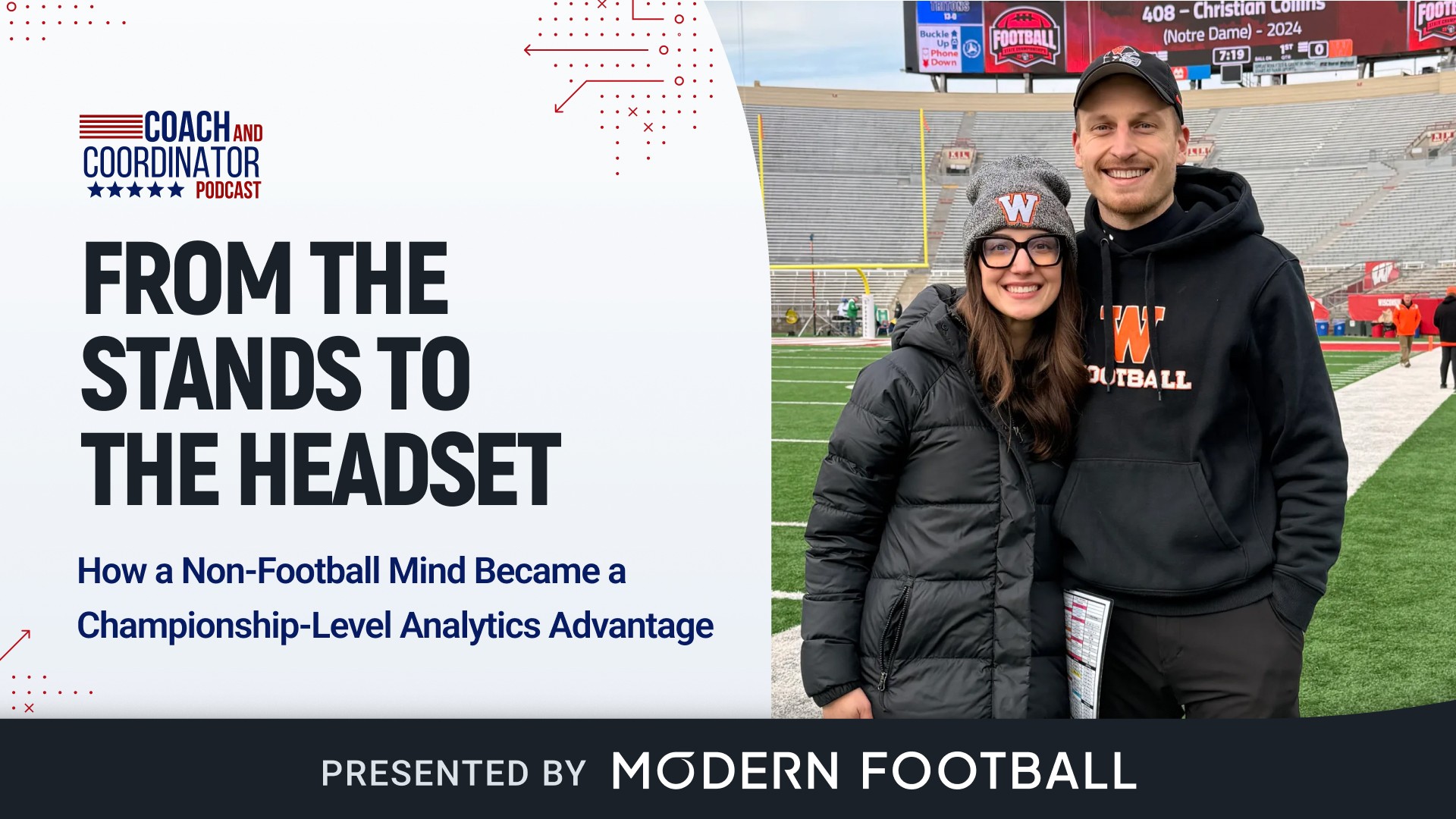
From the Stands to the Headset
1. The Big Picture
When Kegan Wirtz first talked about using live in-game analytics, it sounded like a staffing problem every coach knows too well. He needed real-time data. He didn’t have enough coaches. And piling one more responsibility onto an already overloaded staff just wasn’t working.
The solution ended up being closer than anyone expected.
Madeline Wirtz—Kegan’s wife, a self-described non-football person who once didn’t know the difference between a field goal and an extra point—became the program’s in-game analytics coordinator. What started as a half-joke turned into a two-year system that helped power a deep playoff run and a state championship.
“It was never supposed to be a long-term thing,” Kegan said. “But once we saw how effective it was, there was no going back.”
2. The Problem: More Data, Less Bandwidth
Kegan had already committed to using Modern Football Technology to improve in-game decision-making. The challenge wasn’t belief—it was execution.
Coaches already had position groups and sideline responsibilities
High-tempo offenses made real-time charting nearly impossible
Partial data or delayed tagging meant missed in-game adjustments
Postgame work spilled into long Saturday mornings
“We couldn’t make it through two plays with our original setup,” Kegan explained. “Everyone wanted to coach. No one could just chart.”
3. The Unlikely Solution
Madeline’s background wasn’t football—it was operations. She’s a nursing home administrator who works with data and systems every day. But football? That was new.
Before the first game, Kegan walked her through film at home:
Inside run vs. outside run
Dropback, sprint out, RPO
Formation, strength, play direction
They practiced the exact inputs she’d be responsible for on game day. By the time the season started, Madeline didn’t need to understand everything—she just needed to understand her role.
“The app tells me exactly what I need to enter and in what order,” she said. “Ball spot, hash, call, formation, result—it’s laid out logically. That made it possible.”
4. Game Day Execution
On Friday nights, Madeline is on the sideline with a headset, tagging plays live while Kegan coaches. Between series and at halftime, she delivers exactly what he needs—no noise, no guessing.
They track different things each week based on the opponent:
Play direction vs. option teams
Ball carrier tendencies
Field vs. boundary behavior
Blitz and stunt efficiency
Situation-specific data like P&10 or second-down calls
“We’re not tracking data just to track it,” Kegan said. “We’re tracking what we’re actually going to use.”
One playoff game told the story perfectly. A defensive stunt was working—nine times in a row.
“Nine for nine,” Kegan told the staff at halftime. “We’re not stopping until they stop it.”
That stunt stayed in. It kept working.
5. Confidence, Buy-In, and Speed
The impact wasn’t just tactical—it was cultural.
Players started asking Madeline what she was seeing. Coaches trusted the numbers. Halftime conversations shifted from gut feel to evidence.
“Instead of ‘what do we think is working,’ it became ‘here’s what’s working,’” Kegan said.
And when the final whistle blew?
“All the data is done,” Kegan added. “Saturday morning takes less than five minutes. If the clips line up, it’s plug-and-play.”
What used to steal hours now takes moments.
6. Beyond the Sideline
For Madeline, the experience went far beyond analytics.
“I finally understood why he puts so much time into football,” she said. “Being on the sideline—you feel the energy, the pressure, the impact on kids’ lives.”
What once separated football from family time became something they shared. Film sessions. Game nights. Even postgame wins.
“The first hug I gave after we won the state championship was to her,” Kegan said.
They’ve already ordered another ring to go with the wedding bands.
7. The Takeaway
This wasn’t about finding another coach.
It was about finding the right role—and the right tool—to make in-game analytics work without overloading the staff.
“It doesn’t have to be a football expert,” Kegan said. “It just has to be someone who can lock into the process.”
For the Wirtzes, that process delivered faster decisions, better adjustments, saved time, and a championship—proving that sometimes the smartest football minds come from outside the football building.
Duration:
32 Min