Article
The Play Caller’s Paradox
Escaping the Trap of Thin-Slicing Data
In today’s era of data-driven football, we have access to more scouting data, film cutups, and tendency breakdowns than ever before. But more isn’t always better. One of the biggest traps modern offensive coordinators fall into is thin-slicing data —breaking down plays so narrowly that it becomes statistically tidy, but operationally useless.
When you're calling plays in real time, you don’t get 100 chances to prove a theory. You get 25–30 plays in a half. The real question isn’t, “What’s their tendency in 2nd-and-medium against 11 personnel in the middle third?” It’s, “What play is going to move the ball right now?”
This is where Modern Football helps. There are a handful of unit goals you track in real-time—like play efficiency, personnel groupings, and key tendencies. Modern Football gives you this ability live on the sideline, not after the game.
What happens when you thin slice play call data
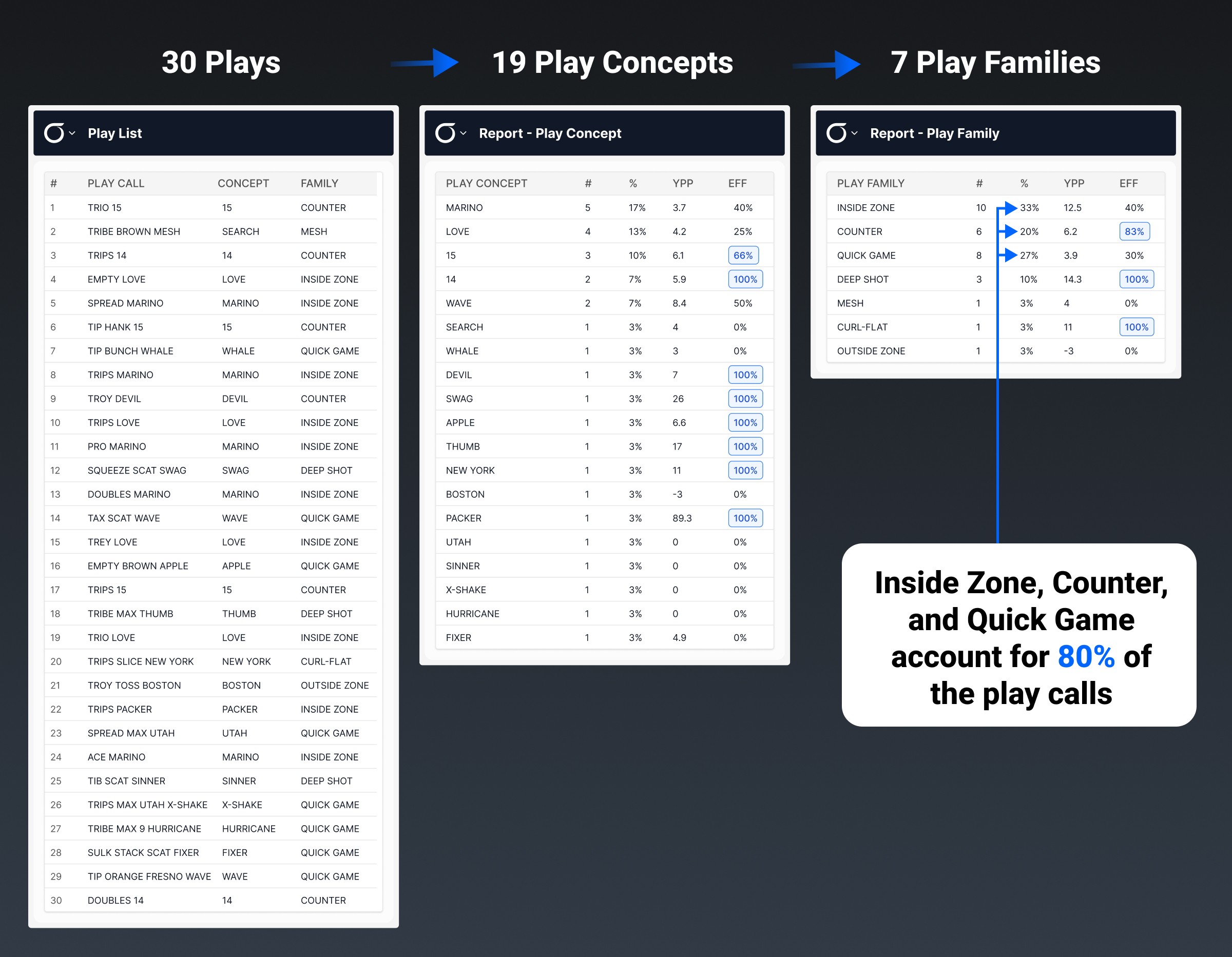
In a 30 play sample, you're evaluating one-offs — plays called once or twice — which doesn’t provide enough data to measure true success or efficiency.
You might overvalue or undervalue a single play due to variance (e.g., a busted coverage or missed block).
It clouds your understanding of what the defense is reacting to — they're responding to families and concepts, not specific tags or formations
Why Grouping by Family/Concept is Better:
Grouping reveals true tendencies — how often you're running gap vs zone, or dropback vs quick game.
You can identify core efficiency trends — which run or pass concepts consistently move the ball.
It allows for scheme-level self-scouting — you’re not chasing play names, you’re improving structural ideas.
Defenses don’t game plan for “TRIPS 15,” they game plan for “COUNTER” or “INSIDE ZONE.”
Let's look at a 30 play sample:
The Illusion of Specificity
Defensive coordinators know exactly what opposing offenses are taught to read. Many are now gaming the system — self-scouting harder than offenses and intentionally breaking their own tendencies. Rotating coverages late, disguising fronts, or baiting offenses into calling certain plays are the ultimate ways elite DCs are weaponizing Modern Football.
You may see a defense running Cover 3 on 70% of 1st-and-10s — but what does that actually mean when you only have five 1st-and-10s in a half, and two came in hurry-up?
If you're not careful, tendency reports can box you in — making you reactive instead of aggressive. What’s more useful is identifying which concepts are moving the ball during the game, not the ones you expected.
Modern Defensive Coordinators don’t care about every variation of a play concept — they care how a concept hits overall. If your counter concept variations and pin-pull all create the same run fits and protection rules, then it’s the same problem for Defensive Coordinators to solve. So why are we over-labeling and under-executing?
Flip the Lens: Broaden Your Scope
Here’s how to flip your mindset and simplify your approach under pressure:
Group concepts, not just plays.
Focus less on tagging every variation and more on what stresses an opponent’s structure. You don’t need to know the success rate of every single play — just which families are efficient across quarters and situations.Track efficiency, not just matchups.
Forget “favorite plays” and start asking: What consistently gains yards? Track the Magic 3 metrics: Frequency, Yards per Play, and Efficiency.Timing is everything in life, including play calling.
Focus more on timing and situational aggression rather than play calling perfection. Use your Magic 3 metrics to monitor play call effectiveness and time exactly when to call your wrinkles. That’s your competitive edge that will produce explosive plays.
If you’re off track, the decisions you make in-game will look different if you have Modern Football’s platform. This is the competitive advantage Modern Football provides.
See how it works →
That’s Where Modern Football Comes In
Instead of guessing which tendency might hold up, we give you real-time insights — immediately on the sideline. Modern Football is the only provider of true, real-time efficiency metrics:
Personnel groupings
Formations
Play concepts & families
Defensive structures you’re facing
We show you what’s working — right now. All four quarters, not just at halftime.
While others are still tagging plays, you’re making confident calls based on live, in-game efficiency.
Modern Football gives you direction — not just data — at the speed of the game.